Meritíssimo · Our dishes · Coxinha
Shredded chicken, a dough made with chicken broth, and the shape of a drumstick. The most ordered salgado in Brazil — its story, its legend, and what we fry here.
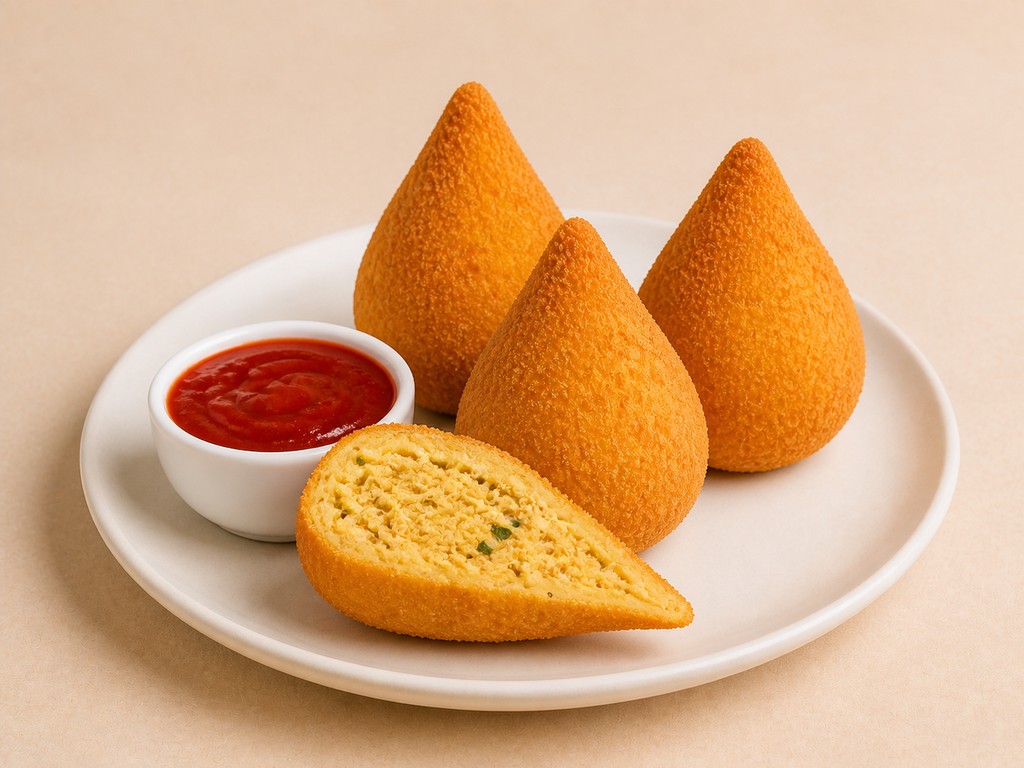
If you point at one thing in a Brazilian bakery window and ask what it is, it is usually the coxinha — the teardrop with the little peak on top. Shredded chicken inside, a soft dough around it, breadcrumbs outside, fried until it is the color of honey.
The name says it: coxinha means little thigh. The shape is a deliberate copy of a chicken drumstick, peak and all. Everything about it is engineered around that idea — the filling is thigh meat pulled apart by hand, and the dough is not made with water but with the broth the chicken was cooked in. That is the detail that separates a good coxinha from a dry one: the dough itself tastes of chicken before you reach the filling.
The story everyone tells is this one. On a farm in Limeira, in the interior of São Paulo, lived a son of Princess Isabel and the Count d’Eu. The boy was difficult at the table and would only eat chicken thigh. One day there were more hungry people than there were thighs, so the cook shredded the whole bird, wrapped the meat in dough, shaped it like a drumstick and fried it. The Empress Teresa Cristina heard about it, approved, and the snack spread.
It is a good story. It is also a legend — it circulates widely and no one has produced a document behind it. Limeira likes it enough to claim the coxinha as its own, and we are not going to argue with a city about that.
What is solid is the bigger picture: the coxinha belongs to the family of European breaded croquettes that arrived in Brazil in the 19th century and were rebuilt here with local ingredients and local habits. It became the anchor of the salgado counter — the snack you eat standing up, at a bakery, between things.
Our menu includes coxinha with Catupiry alongside chicken and beef-rib versions. Catupiry is a brand of creamy requeijão, created in 1911 in Lambari, Minas Gerais. Its history is part of the Brazilian bakery story; you can read the brand’s own account below.
It is not. An empanada is dough folded around a filling and baked or fried. A coxinha is a cooked dough moulded around meat by hand, then breaded. Different family entirely — and in Brazil the folded one has its own name, pastel.
A coxinha is a filled snack, not a bone-in chicken drumstick. Our menu includes chicken, chicken with Catupiry and beef-rib fillings. Read the description to choose the filling you want.
Party trays are real — we fry them by the hundred for birthdays and office meetings. But in Brazil the coxinha is an everyday thing: one at eleven in the morning, standing at the counter, with a coffee or a guaraná.
Three come out of our fryer: chicken coxinha ($5.49), coxinha with catupiry ($6.49), and the one we are proudest of — beef rib coxinha with catupiry and cream cheese ($7.49), made with slow-cooked rib meat instead of chicken. For parties, we fry salgados by the hundred: see catering.
Fried fresh through the day. Order pickup online, or call and we will have them hot at the counter.
Order pickup See the menu (978) 855-6347At Meritíssimo, 377 John Fitch Hwy in Fitchburg. Our menu includes chicken coxinha, coxinha with catupiry and beef rib coxinha. Check the menu for current choices and prices.
Shredded chicken, seasoned and pulled apart by hand, wrapped in a dough made with the chicken broth itself, breaded and fried. Ours also come with catupiry cream cheese, or with slow-cooked beef rib instead of chicken.
Coxinha means little thigh. The shape copies a chicken drumstick — that is the whole idea of the snack.
It is a legend. The story of the boy in Limeira who only ate chicken thighs is a popular story that we do not present as a proven origin. What is documented is that the coxinha grew out of the European croquette tradition remade in Brazilian bakeries.
Yes — we fry salgados by the hundred or by the tray for birthdays, church events and office meetings. Tell us the date and how many people and we will send a quote.
No. Brazilian salgados are seasoned, not hot. Pepper goes on the table, not in the dough.
Since October 11, 1994
Argemiro left the truck behind to be near his children. Salomé cooked the first plate — two reais and fifty cents. Since 1994, the same family serves the same food, now in Fitchburg too.
Read our story