Meritíssimo · Our dishes · Pamonha
Fresh corn cooked inside its own husk. Indigenous in origin, tied to Brazil’s winter festivals — and no, you do not eat the wrapper.
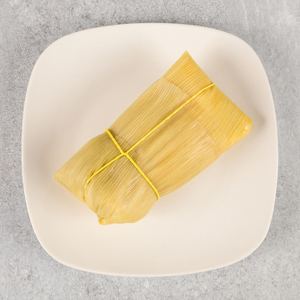
Fresh corn, grated and turned into a paste, wrapped in the husk of the same corn and boiled. Nothing else is needed — the wrapper, the flavour and the perfume all come from one ear of corn. Pamonha is one of the oldest things you can eat in Brazil, and it was here long before Brazil was.
The word comes from Tupi, the language spoken along the coast before the Portuguese arrived. Corn was already a staple of indigenous cooking, and cooking it wrapped in its own husk was already the technique. The Portuguese added sugar and, later, cheese. The structure of the thing is native.
It belongs to the corn harvest, which in Brazil falls in June and July — the same weeks as the festas juninas, the winter street parties with bonfires, quadrilha dancing and a table of nothing but corn: pamonha, curau, canjica, corn cake, corn on the cob. If you have never been to one, that table is the best argument for going.
Pamonha doce is the corn on its own terms: sweet, soft, milky, usually with a piece of cheese in the middle that melts into it. Pamonha salgada goes the other way — salt, cheese, sometimes sausage — and eats like a light meal rather than a dessert.
Goiás built an entire roadside culture on these two, with pamonharias along the highways selling nothing else. In Minas it is more of a home thing, made when the corn is right.
It sounds obvious and it is the single most common mistake made by people eating their first one. The husk is the pan, not the food. Open it, eat what is inside, with a spoon or with your hands.
Same corn, different form. Curau is a spoonable corn pudding served cold in a cup, dusted with cinnamon. Pamonha is firm, wrapped and boiled. Confusing the two is a rookie error and any Brazilian will correct you affectionately.
In Brazilian slang, calling someone pamonha means they are soft, slow, a bit of a pushover. It is affectionate more often than not — the kind of thing a grandmother says.
We have both. Pamonha salgada com queijo and pamonha doce com queijo, at $7.30. Eat it warm — cold pamonha is edible, warm pamonha is the point.
Ask us to warm it. Order pickup online, or call and we will have it ready.
Order pickup See the menu (978) 855-6347Fresh corn grated into a paste, wrapped in the husk of the same corn and boiled. It comes sweet or salty, usually with cheese in the middle.
No. The husk is the wrapper it cooks in — open it and eat what is inside.
No. Curau is a soft corn pudding served cold in a cup with cinnamon. Pamonha is firm, wrapped in husk and boiled.
Both, with cheese, at $7.30 each. Ask us to warm it — that is how it should be eaten.
Since October 11, 1994
Argemiro left the truck behind to be near his children. Salomé cooked the first plate — two reais and fifty cents. Since 1994, the same family serves the same food, now in Fitchburg too.
Read our story