Meritíssimo · Our dishes · Frango com quiabo
Chicken, okra and a pan of angu. The Sunday plate of Minas Gerais — where the okra came from, and the trick that keeps it from turning slippery.
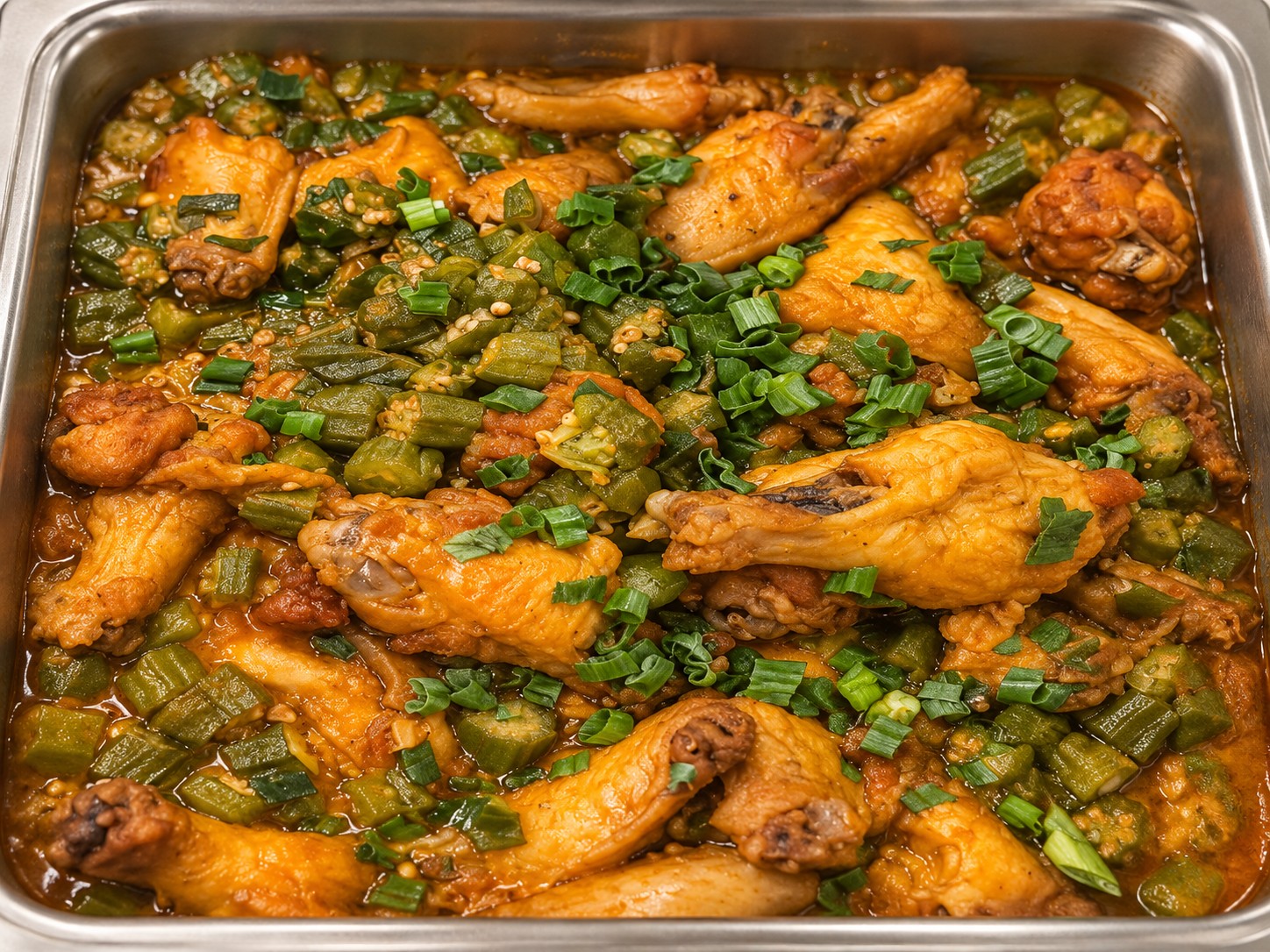
Chicken browned in its own fat, okra cut by hand, and a pan of angu — soft white cornmeal — next to it. Frango com quiabo is the Sunday plate of Minas Gerais, the one that gets made when the family is coming over, and the one that separates a cook who knows okra from a cook who does not.
Okra is not native to Brazil. It came from Africa, carried across the Atlantic during the slave trade, and it took root in Brazilian cooking so completely that today nobody thinks of it as foreign. The word quiabo itself comes from an African language. In Minas it met chicken and cornmeal and never left.
That history is worth saying out loud, because the African hand in Brazilian food is usually mentioned only next to feijoada, and it is in far more than that — in the okra, in the technique, in the way a pan is seasoned.
Everyone who dislikes okra dislikes it for the same reason: it turns slippery. That is not the vegetable’s fault, it is the cook’s. Okra releases that liquid when it meets water and low heat. So:
Wash it before cutting, never after. Dry it completely — knife, board and hands dry too. Cut it and take it straight to a hot pan with fat, not a warm one. A splash of lemon or vinegar helps. Done right, the pieces come out firm, slightly browned at the edges, and there is no slime at all.
The plate comes with angu: white cornmeal cooked slowly with water and salt until it thickens, and nothing else. No butter, no cheese, no stock. Italian polenta is yellow, richer and usually finished with fat — angu is deliberately plain, because its job is to carry the sauce from the chicken, not to compete with it.
In this plate the okra is not a garnish. It cooks in the chicken sauce and thickens it slightly — that body is the point of the dish.
It is chicken, a green vegetable and cornmeal. Compared with most of what sits on a Brazilian counter, this is the light one.
Frango com quiabo is buffet food — it belongs to the hot line at lunch, with rice and beans beside it, where you take as much as you want by the pound. It is not on the menu every day of the week. Ask us at the counter, or call before you come, and we will tell you what is in the pans today.
Ask what is in the pans today. Call us before you come and we will tell you what is on the hot line.
Order pickup See the menu (978) 855-6347A dish from Minas Gerais: chicken browned and stewed with okra, served with angu — plain white cornmeal cooked with water and salt.
Not when it is cooked properly. Okra releases that liquid when it meets water and low heat, so it is washed before cutting, dried completely, and taken straight to a hot pan.
No. Angu is white cornmeal cooked only with water and salt, deliberately plain so it carries the sauce. Polenta is yellow, richer and usually finished with butter or cheese.
It is a buffet dish and it rotates through the week. Call us or ask at the counter and we will tell you what is on the hot line today.
Since October 11, 1994
Argemiro left the truck behind to be near his children. Salomé cooked the first plate — two reais and fifty cents. Since 1994, the same family serves the same food, now in Fitchburg too.
Read our story